







ORLEN and Hungary's MVM ONEnergy explore LNG supplies to Hungary via Poland
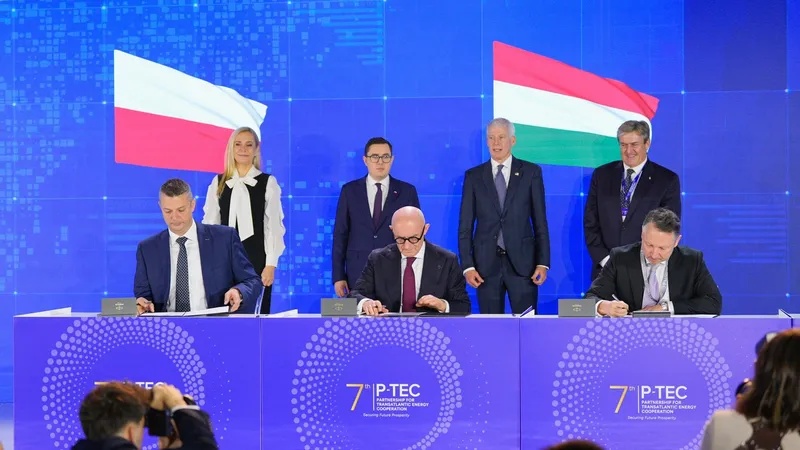
ORLEN and Hungarian energy trader MVM ONEnergy have signed a memorandum on potential cooperation covering LNG deliveries to Polish terminals, regasification and the transport of natural gas to Hungary. The document was signed on 18 November 2026 in Warsaw, during the seventh ministerial meeting of the Partnership for Transatlantic Energy Cooperation (P-TEC).
In brief
ORLEN and Hungary's MVM ONEnergy signed a memorandum at the P-TEC summit in Warsaw on potential cooperation covering LNG deliveries to Polish terminals, regasification and gas transport to Hungary. The deal supports ORLEN's Baltic Eagle Gas Hub concept and Hungary's efforts to diversify gas supply routes.
The aim is to develop secure and commercially competitive solutions that would diversify the sources and routes of gas supplies to Hungary and strengthen the energy resilience of Central and Eastern Europe. Talks will cover access to infrastructure as well as the organisation and terms of supplies. Companies from both groups may take part, including ORLEN LNG Trading Limited and ORLEN Energy Trading GmbH.
– Energy security in Central and Eastern Europe requires diversified sources and routes of gas supply and cooperation between partners in the region. In our talks with MVM ONEnergy, we want to draw on ORLEN's experience in sourcing LNG and organising gas supplies to European markets. The agreement combines two goals that are important to us: strengthening the region's energy security and developing ORLEN's presence on the Hungarian market – said Ireneusz Fąfara, CEO of ORLEN.
– With this strategically important agreement with ORLEN, we are further strengthening security of supply to Hungary and the entire region. It is another milestone in diversifying gas supplies to Hungary, because in addition to deliveries via the southern route, LNG will also be able to arrive from Poland. Drawing on ORLEN's knowledge and experience, MVM ONEnergy can further develop its LNG business and trading. The memorandum is fully in line with MVM Group's strategic objectives and with the expectations set for Hungary under the EU's REPowerEU plan – said Gábor Orbán, CEO of MVM ONEnergy.
Hungary widens its LNG options
MVM is Hungary's state-owned energy group, active in power generation, distribution and sales, as well as gas trading, storage and distribution. It owns the Paks nuclear power plant. MVM ONEnergy handles the group's wholesale gas and electricity trading and operates subsidiaries in Austria, the Czech Republic, Slovakia, Croatia, Serbia and Bulgaria.
The company has been building up its LNG portfolio. In December 2025 it signed a five-year deal with Chevron for around 2 billion cubic metres of gas, with deliveries starting on 1 October 2027.
The new memorandum is not a firm supply contract. According to the Polish business daily Parkiet, a key question will be cost: gas imported through Poland is currently more expensive for Hungarian buyers than existing routes. Parkiet also noted that Hungarian companies had considered booking capacity at the planned second FSRU in the Gulf of Gdańsk, where ORLEN has already reserved regasification capacity.
Poland as a gateway for US gas
The agreement is part of ORLEN's Baltic Eagle Gas Hub concept, a regional gas supply and trading centre combining access to the global LNG market with Baltic import infrastructure and cross-border connections. It aims to strengthen Poland's role as a gateway for US LNG into Central and Eastern Europe, relying on ORLEN's capacity at the Świnoujście and Klaipėda terminals, the planned FSRU terminals in the Gulf of Gdańsk and its own fleet of LNG carriers.
The MVM memorandum was one of several regional gas deals ORLEN announced around the P-TEC summit. On the same day it signed an agreement with Slovakia's SPP, the country's largest energy supplier, and a day earlier it announced a new contract with Ukraine's Naftogaz for gas from three US LNG cargoes in the first quarter of 2027.
Source: Gazeta Morska
Comments (0)
The discussion is moderated by the editors: a comment appears after review. Your e-mail address is not published.
Nobody has commented on this article yet.