







Keel laid for Huragan in Gdynia, all three Miecznik frigates for the Polish Navy now under construction
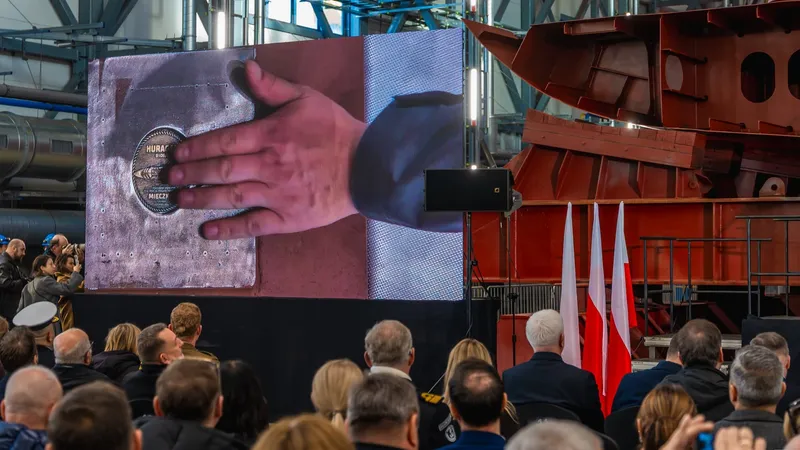
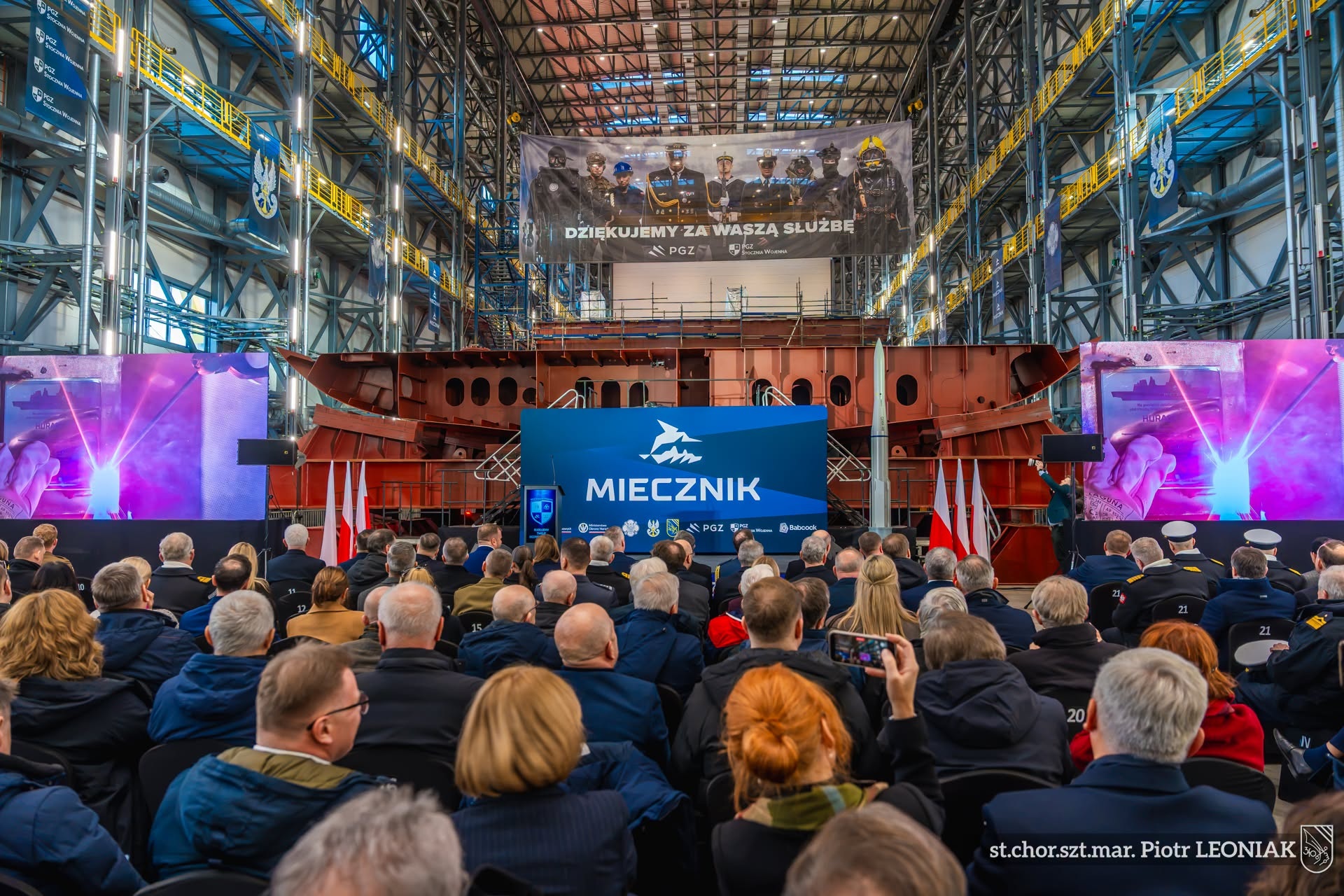
The keel of Huragan, the third multi-role frigate in Poland's Miecznik programme, was laid in the hull hall of PGZ Stocznia Wojenna in Gdynia on 24 November 2026. All three frigates ordered for the Polish Navy are now in production, and the programme is due to be completed by the end of 2031.

In brief
The keel of Huragan was laid in Gdynia, so all three Miecznik frigates for the Polish Navy are now under construction, with completion due by 2031.
Ministers from Poland and the UK at the ceremony
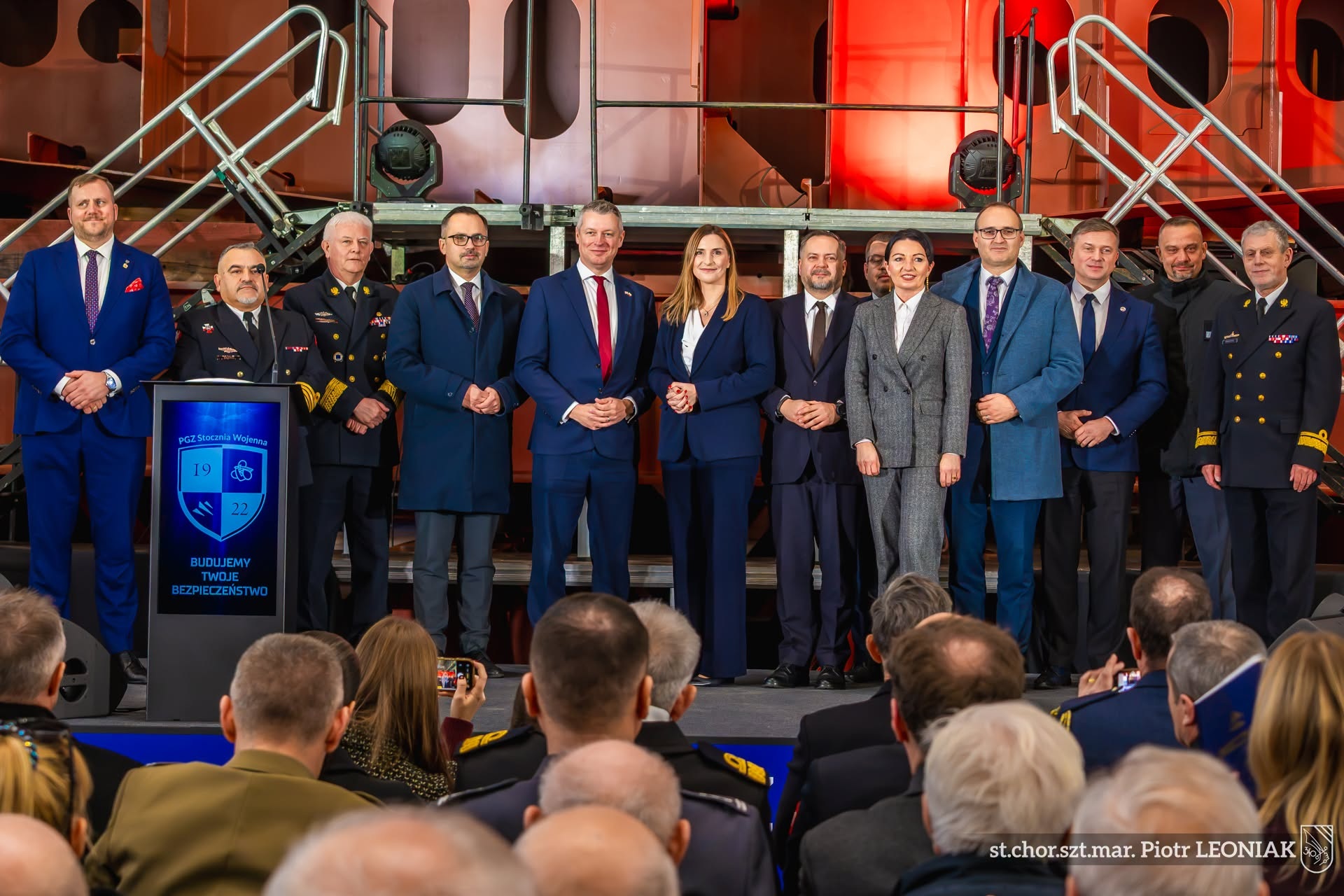
The ceremony was attended by Magdalena Sobkowiak-Czarnecka, Secretary of State at Poland's Ministry of National Defence, Luke Pollard, Minister of State at the UK Ministry of Defence, Konrad Gołota, Under-Secretary of State at the Ministry of State Assets, and Vice-Admiral Jarosław Ziemiański, Inspector of the Polish Navy. Polska Grupa Zbrojeniowa (PGZ) was represented by first vice-president Arkadiusz Bąk and vice-president Piotr Zawieja. The Polish classification society Polski Rejestr Statków sent its president Grzegorz Pettke and board member Katarzyna Sobczak-Bergmann.
Addressing the shipyard workers, Magdalena Sobkowiak-Czarnecka praised the yard for keeping to schedule and for its cooperation with partners. She said the ceremony completed the stage in which the frigates entered production.
– I have great respect for the work you do here. Congratulations to the president, but also to the whole team. Timeliness, the highest quality and fantastic cooperation with partners, for which I am very grateful. Today's ceremony closes the Miecznik programme in the sense that all three are now in production, and this programme is unique for the Polish Armed Forces – said Magdalena Sobkowiak-Czarnecka.
Deputy Prime Minister and Defence Minister Władysław Kosiniak-Kamysz sent a letter to those attending. He linked the programme to the strategic importance of the Baltic and Poland's place in NATO.
– Laying the keel of the future frigate ORP Huragan is another important step in building and modernising the capabilities of the Polish Navy. The Baltic Sea is of particular strategic importance today. The security of its waters, shipping routes and critical infrastructure determines not only the economic stability of our country, but also the security of the whole region. Investment in modern naval forces is therefore an essential part of building a strong state and a credible position for Poland in the North Atlantic Alliance – Władysław Kosiniak-Kamysz wrote.
A 127-tonne keel section
Huragan's keel weighs about 127 tonnes, roughly 4.5 per cent of the hull mass. It is 24 metres long and 18 metres wide and is built from high-tensile steel. Lloyd's Register rules require a keel of at least 1 per cent of hull mass and no less than 50 tonnes.
Following shipyard tradition, a commemorative medal was welded into the keel. The keel-laying certificate was signed by representatives of Lloyd's Register, the customer and the shipyard. The yard's president said Gdynia now has the capacity to build more ships of the class.
– Laying the keel for Huragan is the third such moment in the Miecznik programme. Today we have the capability to build further ships of this class as well, should the navy consider it necessary. For now we are concentrating on building well the ships we are working on today, and for that I thank the workforce – said Marcin Ryngwelski, president of the management board of PGZ Stocznia Wojenna.
Wicher afloat, Burza in the hall, Huragan just started
Construction of Huragan began with steel cutting on 28 April 2026. The first frigate, Wicher, was christened on 12 August 2026 and launched the following day, and is now being fitted out at the yard. The keel of the second ship, Burza, was laid in December 2025 and its hull is being assembled in the hull hall.
Miecznik is the largest shipbuilding programme in the history of the Polish Navy. The three frigates will replace ageing ships of the Polish fleet. They are based on Babcock International's Arrowhead 140 design, adapted to Polish Navy requirements, and are being built by the PGZ-Miecznik consortium of PGZ and PGZ Stocznia Wojenna. The contract is worth more than PLN 15 billion.
Roles and key figures
The frigates are intended to counter air, surface and underwater threats and to protect shipping routes and critical infrastructure. Poland's Armament Agency says they will strengthen the navy's ability to monitor and control sea areas, protect naval bases, engage surface, underwater and coastal land targets and provide maritime air defence, in both national and NATO operations.
The ships will be fitted with an Integrated Mission System covering the bridge, communications, the platform management system and the combat system with its sensors and effectors. They will carry air and missile defence systems, weapons against surface and land targets, and torpedoes for anti-submarine warfare. The Armament Agency gives the following basic figures:
- Overall length: about 138 m
- Maximum beam: about 20 m
- Maximum displacement: about 7,000 tonnes
- Range: about 8,000 nautical miles
- Top speed: 28 knots
- Propulsion: four diesel engines in a CODAD arrangement, two controllable-pitch propellers
- Crew: 120, plus about 60 additional personnel
Shipyard workforce heading for 1,500
The programme has transformed the Gdynia yard. Magdalena Sobkowiak-Czarnecka gave the workers figures on employment and revenue over the past three years.
– If we look at the shipyard's results, over the past three years employment here has grown from a few hundred people to more than 1,200, and next year it will be 1,500. This is how we are rebuilding the shipbuilding industry. The yard's revenue has grown by a billion zlotys in three years – she said.
The defence minister's letter also stressed the programme's value for Polish industry, describing it as an investment in the knowledge, experience and future of the defence sector. PGZ points out that the navy's order translates into work across the group and for domestic suppliers.
– Cooperation with foreign partners makes the most sense when it builds capability in Poland. That is the case in the Miecznik programme: we draw on the experience of Babcock International and British industry, and at the same time we develop our own skills at the shipyard, across the Group and among our subcontractors. The navy's order translates here into production, investment, jobs and orders for domestic suppliers. That is how we understand producing Polish security – said Arkadiusz Bąk, first vice-president of PGZ.
Michał Kowalski, a Law and Justice (PiS) member of parliament from Pomerania, thanked Gdynia's shipbuilders and engineers. He recalled that the frigate programme was launched by his party on the initiative of Mariusz Błaszczak, then defence minister, and said the investment meant jobs, orders for local companies and career opportunities for young engineers and technicians in the region. He called for deadlines to be met so that the frigates enter service as soon as possible, adding that Poland needs a strong navy able to protect its ports, shipping routes and Baltic infrastructure.
Polish and British frigates under the NATO flag
Poland and the United Kingdom signed two project arrangements during the ceremony, one on the preliminary concept phase of the CAMM-MR missile and one on cooperation between the Type 31 and Miecznik frigate programmes. The Royal Navy's Type 31 frigates are also derived from the Arrowhead 140 design.
Luke Pollard said the Miecznik and Type 31 frigates would sail together under the NATO flag, defending freedom and democracy in the Baltic and the Atlantic, with Polish and British sailors serving side by side. He described cooperation between the two countries as joint development of new technology rather than selling products to each other, and said it would make both stronger while creating good jobs.
Konrad Gołota placed the shipyard's work in a wider national context.
– Poland is increasingly becoming a full-scale maritime state, with all that this entails. What the shipyard is doing and the development of our navy are an expression of that – said Konrad Gołota.
Dual-use jack-up vessel for offshore wind and seabed security
A letter of intent on a dual-use jack-up vessel was also signed in Gdynia by PGZ, PGZ Stocznia Wojenna, the Maritime Technology Centre research and development institute (OBR CTM) and the Crist shipyard. The partners plan to develop the concept together and, once the documentation is complete, to build a fully equipped vessel.
Its primary role would be installing and servicing offshore wind farms. It would also detect and prevent incidents threatening subsea transmission infrastructure and deal with their consequences. The initial concept includes systems for carrying and docking autonomous underwater and surface vehicles and special craft, subsea infrastructure monitoring, coordination with maritime services and green methanol propulsion.
Call not to mute emergency alerts
After the ceremony, Magdalena Sobkowiak-Czarnecka referred to the security situation in the region and recent violations of Polish airspace. She urged the public not to mute or switch off emergency alerts sent to mobile phones.
– Some people, because these alerts come quite often, decided to mute them, and Friday's situation shows this best: a missile fell a few hundred metres from one man's property. I know it may tire you and make you impatient, but your safety is what matters most to us. Ignoring such an alert can even cost a life – she said.
Source: Gazeta Morska
Comments (0)
The discussion is moderated by the editors: a comment appears after review. Your e-mail address is not published.
Nobody has commented on this article yet.