






Karol Nawrocki wraps up Argentina and Chile tour with copper, G20 diplomacy and a high seas treaty bid
Polish President Karol Nawrocki on Friday concluded a five-day trip to Argentina and Chile, the first visit by a Polish head of state to this part of South America in more than 20 years. In Buenos Aires and Santiago he held talks with Presidents Javier Milei and José Antonio Kast, met members of the Polish diaspora and, in the Atacama Desert, visited the Sierra Gorda copper and molybdenum mine, KGHM's largest foreign investment, as well as a Polish astronomical observatory on Cerro Murphy. The visit formed part of Poland's diplomatic campaign ahead of the G20 summit in Miami in December.

In brief
Polish President Karol Nawrocki has concluded a five-day visit to Argentina and Chile, the first in more than 20 years. Javier Milei backed Poland's G20 membership, while talks with José Antonio Kast covered the economy and the High Seas Treaty. The President also visited KGHM's Sierra Gorda mine and the Polish observatory on Cerro Murphy.
The official visits took place from 23 to 27 November, with the President spending Monday and Tuesday in Argentina and Wednesday to Friday in Chile. According to the Chancellery of the President, the trip had diplomatic, economic, scientific and diaspora dimensions. It was the first visit by a Polish president to Argentina in 31 years, since Lech Wałęsa's trip in 1995, and the first to Chile in 24 years, since Aleksander Kwaśniewski's visit in 2002.
Campaigning ahead of the G20 summit in Miami
The main purpose of the trip was G20 diplomacy. The summit of the world's largest economies will be held in Miami, Florida, on 14–15 December, hosted by US President Donald Trump. Poland has been invited to attend by the United States, which holds this year's G20 presidency, and will be represented by the President.
Karol Nawrocki is seeking to turn Poland's guest participation into a permanent seat at the G20 table. Marcin Przydacz, head of the President's International Policy Bureau, stressed before departure that the talks with the leaders of Argentina and Chile were intended to build support for this ambition ahead of the December meeting.
Buenos Aires: the Polish community and talks with Javier Milei
The President began his visit to Argentina at the Polish House in Buenos Aires, home to the Union of Poles in Argentina, which is celebrating its centenary this year. Karol Nawrocki presented state decorations to distinguished members of the diaspora and thanked them for preserving Polish identity thousands of kilometres from home. He noted that both countries will take part in the G20 summit in Miami in December.
– Today Poland and Argentina are among the twenty largest economies in the world – said Karol Nawrocki at the meeting with the Polish community in Argentina.
On Tuesday, the President laid a wreath at the monument to General José de San Martín before being officially welcomed by Argentine President Javier Milei. The leaders focused primarily on trade and economic cooperation, as well as resilience and security. The key outcome of the Buenos Aires leg was President Javier Milei's declaration of support for Poland's membership of the G20. As Argentina is a permanent member of the group, its backing carries particular weight.
Santiago: talks with José Antonio Kast
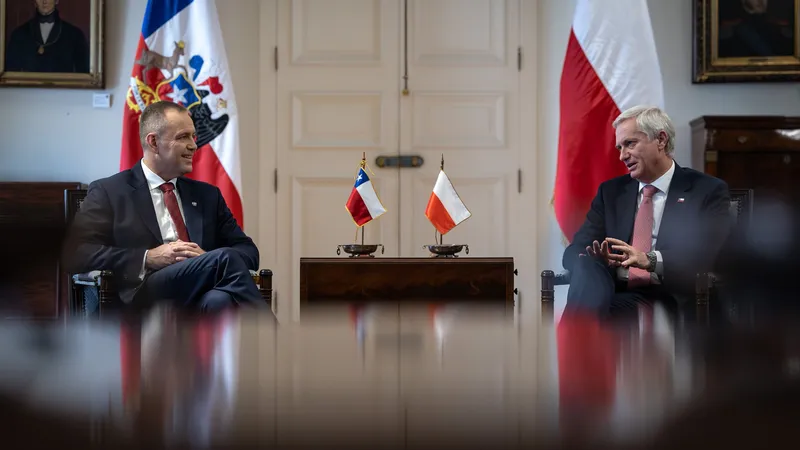
On Wednesday, the President arrived in Santiago, where he also met the Polish community and presented state decorations. On Thursday, he laid a wreath at the monument to General Bernardo O'Higgins and then held talks with Chilean President José Antonio Kast in both restricted and plenary formats. The discussions covered trade, investment, security, mining and scientific cooperation. Karol Nawrocki stressed that modern Polish-Chilean relations have a very concrete economic dimension, with KGHM Polska Miedź's operations in Chile as the best example.
– Polish companies have the capital, technologies and competences to deliver major investment projects – the President said after his talks with José Antonio Kast.
In Santiago, the President also delivered a lecture at the headquarters of the UN Economic Commission for Latin America and the Caribbean (ECLAC) and met its Executive Secretary, José Manuel Salazar-Xirinachs. He spoke about Poland's historical ties with the region, Polish emigration during the partitions and the need for closer cooperation. Chile, one of the world's largest copper producers, is an important partner for Poland in critical raw materials.
– The time has come to give our relations a new impetus – said Karol Nawrocki at ECLAC.
Valparaíso bids to host the High Seas Treaty
Maritime affairs featured prominently in the talks in Santiago. Chile is campaigning for the port city of Valparaíso to host the secretariat of the Agreement on Marine Biological Diversity of Areas Beyond National Jurisdiction (BBNJ), known as the High Seas Treaty. José Antonio Kast's government presents the bid as state policy and a testament to Chile's maritime vocation, and has promoted it at the United Nations.
The parties to the agreement will choose the secretariat's location at their first conference (COP1), to be held in New York from 11 to 22 January 2027. Chilean diplomats had already raised the Valparaíso bid in Poland, and the presidential visit offered a further opportunity to seek Polish support. The treaty covers the protection of marine life in international waters, which account for almost two-thirds of the world's oceans.
Sierra Gorda, a Polish mine in the Atacama Desert
On Friday, the final day of the visit, Karol Nawrocki toured the Sierra Gorda open-pit copper and molybdenum mine in the Antofagasta region, KGHM's largest foreign investment. The Polish company holds a 55 per cent stake, with the remaining 45 per cent owned by Australia's South32. In 2025, the mine produced around 160,000 tonnes of payable copper and more than 8 million pounds of molybdenum, and the President also met Polish employees and managers there.
A fourth ore grinding line worth around USD 725 million is being built at Sierra Gorda and is expected to increase copper production by around 20 per cent. Construction was launched in October 2026 in the presence of Chilean President José Antonio Kast and Poland's Deputy Minister of State Assets Eliza Zeidler. During the visit, KGHM Vice-President Anna Sobieraj-Kozakiewicz presented the President with a copper alloy produced in Poland.
Karol Nawrocki stressed that copper is a strategic raw material and that the mining sector affects the security of both countries. He called the mine "a great success of the Republic of Poland" and a symbol of Polish-Chilean friendship. He also recalled Ignacy Domeyko, the Polish geologist and rector of the University of Chile who helped lay the foundations of Chilean mining in the 19th century and is regarded as a national hero in Chile. At his meeting with the Polish community in Santiago, the President had already said that it is thanks to Ignacy Domeyko that Polish investments can develop at Sierra Gorda today.
– We remember the past and we think about the future – Karol Nawrocki added.
A Polish observatory next to the world's largest telescope
The final stop of the trip was the Rolf Chini Cerro Murphy Observatory, operated by the Nicolaus Copernicus Astronomical Center of the Polish Academy of Sciences. The observatory lies about a kilometre from the summit of Cerro Armazones, where the European Southern Observatory is building the Extremely Large Telescope (ELT), the world's largest optical telescope.
The facility is part of the international Araucaria project, led by Professor Grzegorz Pietrzyński, which studies how fast the Universe is expanding. Following a major rebuild, the observatory was reinaugurated in November 2023 and benefits from some of the clearest skies on Earth. Polish science, Polish industry and the Polish diaspora showed in South America that Poland has genuine interests and partners in the region on which it can build ahead of the G20 summit.
Source: Gazeta Morska
Comments (0)
The discussion is moderated by the editors: a comment appears after review. Your e-mail address is not published.
Nobody has commented on this article yet.