






Italian Navy's Vulcano enters renovated Ferrati dry dock in Taranto
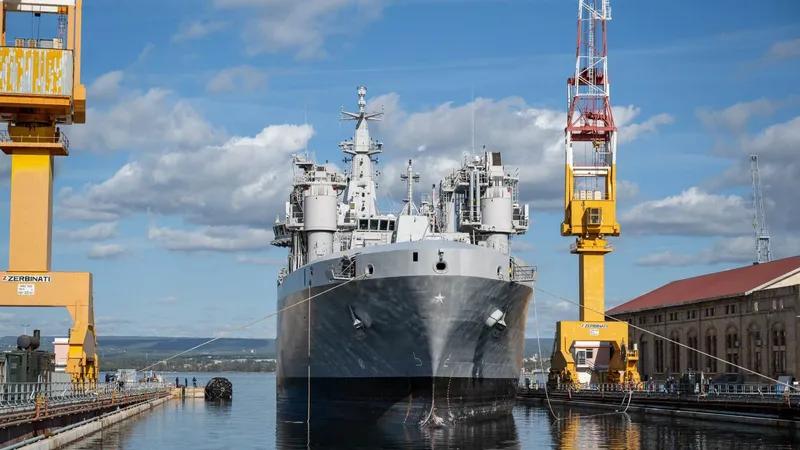
The Italian Navy's logistic support ship Vulcano has entered the “E. Ferrati” dry dock at the Taranto Naval Arsenal for routine underwater hull maintenance. The 243-metre masonry dock, one of the largest in Europe, has just been modernised, two years after an accident put it out of service.

In brief
Italy's logistic support ship Vulcano has entered the modernised 243-metre Ferrati dry dock in Taranto. Read about the arsenal, the ship and how arsenals link Venice with Poland's Zamość.
Bringing the 193-metre ship into the dock required a high-precision manoeuvre and close teamwork between the crew, arsenal staff and tugs.
– Thanks to a manoeuvre of the highest precision and perfect teamwork between the crew, Arsenal personnel and tugs, the logistic support unit reached the dock to prepare to return to sea at maximum operational efficiency – said the Marina Militare.
A 110-year-old dock
The Ferrati dock was built in 1916 and measures 243 by 35 metres. In summer 2024, its old caisson gate collapsed into the basin, flooding the area around it. No one was injured, but the dock was taken out of service. In January 2026, a new 460-tonne steel gate, designated GP73, was launched in Ravenna. It was built by Fincantieri Infrastructure, with Orizzonte Sistemi Navali as prime contractor, under the Italian Navy's arsenal modernisation programme.
The arsenal behind the fleet
The Taranto Naval Arsenal was inaugurated by King Umberto I on 21 August 1889. It built warships from 1894 until 1967 and has since focused on fleet maintenance. It has four docks, two floating and two masonry, employs about 1,500 people, most of them civilians, and services about 70 percent of the Italian Navy's front-line units.
Vulcano (A 5335), delivered by Fincantieri in March 2021, is 193 metres long, reaches about 20 knots and carries 235 crew and specialists. It can carry more than 9,000 m³ of diesel, nearly 4,500 m³ of jet fuel and about 900 m³ of fresh water, along with ammunition, spare parts and food. It has a fully equipped hospital with operating rooms and beds for 17 seriously injured patients. Its design was the basis for France's Jacques Chevallier-class replenishment ships.
From Venice to Zamość
The word arsenal comes from the Arabic dar as-sina’a, meaning “house of manufacture”, and reached Europe through Venice, whose Arsenale built ships from the 12th century and employed some 16,000 workers at its peak. Arsenals also have a Polish history. Jan Zamoyski, who studied in Venetian-ruled Padua, founded Zamość in 1580 as a Renaissance ideal city modelled on Padua, designed by architect Bernardo Morando. Its arsenal was among the town's first major buildings, and Zamość is still called the Padua of the North. Gdańsk had its Great Armoury, built in 1600-1605 and used as an arsenal until 1793. While Polish arsenals mainly stored weapons, Italian ones like Venice and Taranto were naval yards, and Taranto still keeps that tradition alive today.
Source: Gazeta Morska
Comments (0)
The discussion is moderated by the editors: a comment appears after review. Your e-mail address is not published.
Nobody has commented on this article yet.