







Gdańsk University of Technology joins forces with Poland's Autonomous Systems Centre on military unmanned systems
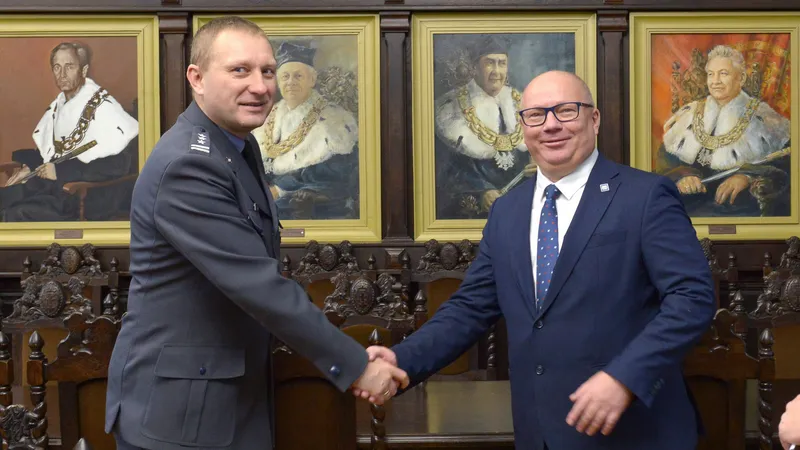
Gdańsk University of Technology has signed a cooperation agreement with the Autonomous Systems Centre (OSA), a science and industry hub supervised by Poland's Ministry of National Defence. The agreement was signed on Wednesday, 25 November 2026, by Prof. Krzysztof Wilde, Rector of Gdańsk University of Technology, and Col. Mariusz Zieja, who heads the centre. The university brings to the partnership more than 40 years of experience in developing unmanned underwater vehicles and solutions for the Polish Navy, including work on the Głuptak mine countermeasures system and technologies used on the Kormoran II-class minehunters.

In brief
Gdańsk University of Technology has signed a cooperation agreement with the Autonomous Systems Centre (OSA), a defence innovation hub supervised by Poland's Ministry of National Defence. The university brings more than 40 years of experience in unmanned underwater vehicles and Navy technologies, including the Głuptak system and Kormoran II minehunters.
A centre built to speed up military innovation
The Autonomous Systems Centre was established in March 2026 on the initiative of the Ministry of National Defence. The agreement creating it was signed on 19 March at the Air Force Institute of Technology (ITWL) in Warsaw, in the presence of Deputy Prime Minister and Defence Minister Władysław Kosiniak-Kamysz and Secretary of State Cezary Tomczyk. ITWL took on the role of project leader.
OSA brings together military research institutes, the IDEAS research institute and Polish Armaments Group (PGZ). Its task is to match the capabilities of scientists and industry with the needs of the armed forces and to accelerate work on unmanned systems. The centre is intended to shorten the path from concepts and technology demonstrators to solutions ready for operational use by the Polish Armed Forces.
The agreement with Gdańsk University of Technology is designed to make wider use of the university's research potential in developing domestic autonomous technologies for defence. For OSA, it brings a significant boost in the maritime domain, where the Gdańsk university is one of Poland's most experienced research centres.
Four decades of underwater technology
For more than 40 years, research teams at Gdańsk University of Technology have designed and developed unmanned and autonomous underwater vehicles. The university also specialises in marine environmental monitoring systems, hydrographic technologies, navigation and control systems, and solutions for protecting critical infrastructure.
These capabilities have been confirmed by long-standing cooperation with the Polish Navy. The university's researchers took part in the design and development of the Głuptak mine countermeasures system, and their technologies have been deployed on the Kormoran II-class minehunters, the most modern mine warfare vessels in the Polish fleet.
– We are a university whose great strength is maritime technology. For years we have been developing solutions used by the Navy, and our experience also covers unmanned systems operating on and under the water. These are capabilities that set us apart among Polish technical universities. We want to use them in cooperation with OSA so that further solutions developed by our scientists can serve the security of the country – said Prof. Krzysztof Wilde, Rector of Gdańsk University of Technology.
Tukan, Pirania and drone swarms
Gdańsk University of Technology works with key players in Poland's defence industry, including Polish Armaments Group and WB Group. Joint projects include the Tukan autonomous underwater vehicle (AUV), the Pirania remotely operated vehicle (ROV) and the Głuptak mine countermeasures system, as well as swarm technologies and autonomous wireless networks.
The university also hosts a NATO DIANA Living Lab, which supports the development and testing of advanced dual-use technologies. Its presence in Gdańsk links the university directly to the Alliance's defence innovation ecosystem.
Bridging the laboratory and the fleet
A key role in transferring research results to the military is played by the university's Centre for Security and Defence Technologies (CTBO). It acts as a bridge between academic research and the practical implementation of solutions for national security.
CTBO develops expertise in underwater acoustics, passive ship protection, deep-sea technologies, and technologies for protecting infrastructure and equipment operating in the marine environment. It is able to cover the full cycle of work, from research and design to implementation and in-service support. That makes it a natural partner for the Polish Navy, the Ministry of National Defence and defence companies.
Why autonomy matters in the Baltic
The agreement with OSA opens the way for the university's experience to be applied in further projects involving autonomous systems for the Polish Armed Forces. With its expert staff, research infrastructure and track record of implementation, Gdańsk University of Technology is an important part of Poland's emerging ecosystem for autonomous technologies, particularly at sea.
The need for such capabilities in the Baltic is growing. Protecting subsea cables and pipelines, detecting mines, carrying out reconnaissance and monitoring shipping increasingly require unmanned surface and underwater vehicles that can operate for long periods without putting crews at risk. Closer ties between a leading maritime university and a military innovation centre could help such solutions move faster from laboratories in Gdańsk to the Polish Navy.
Part of a wider push on unmanned systems
The Gdańsk agreement is part of a broader effort by the Polish Ministry of National Defence to build a domestic base for unmanned and autonomous systems. Since its creation in March, OSA has focused on bringing together military institutes, state-owned industry and research organisations to test and validate new solutions more quickly.
By adding a university with deep expertise in maritime robotics, the centre significantly strengthens its expertise in the underwater domain. For the Polish Navy, which is modernising its mine countermeasures and coastal defence capabilities, that could mean faster access to domestically developed technologies tailored to the specific conditions of the Baltic Sea.
Source: Gazeta Morska
Comments (0)
The discussion is moderated by the editors: a comment appears after review. Your e-mail address is not published.
Nobody has commented on this article yet.