







French Navy admits fourth Suffren-class nuclear attack submarine De Grasse into active service
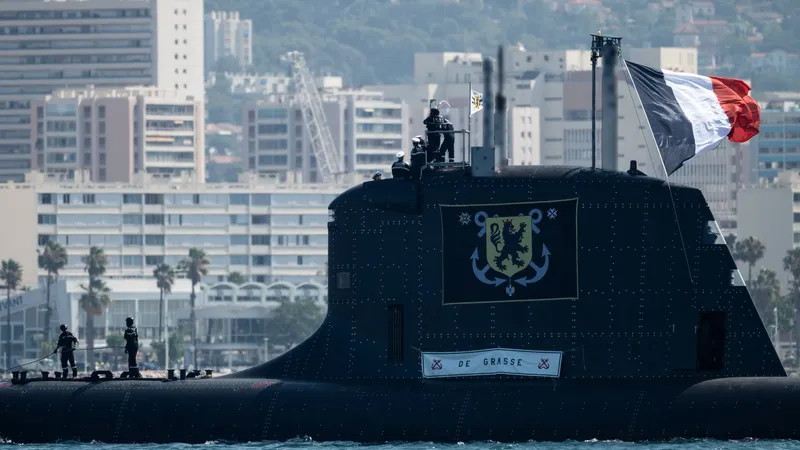
The French Navy's nuclear-powered attack submarine De Grasse was admitted into active service on 20 November 2026, following a decision announced by the Chief of Staff of the French Navy, Admiral Christophe Cluzel. She is the fourth of six Suffren-class boats built under the Barracuda programme to replace the ageing Rubis class, and she can now be deployed on operations. The milestone for France comes as Poland begins delivering its own long-awaited submarine programme, Orka, built around three conventional Swedish A26 boats.

In brief
France's nuclear-powered attack submarine De Grasse, the fourth Suffren-class boat of the Barracuda programme, entered active service with the French Navy on 20 November 2026. We look at her trials, specifications and weapons, and at Poland's Orka programme, under which Warsaw ordered three Swedish A26 conventional submarines from Saab.
Fourth of six Suffren-class boats
According to the French Ministry of the Armed Forces, De Grasse joins three sister boats that are already in service. The lead boat, Suffren, was commissioned in June 2022, followed by Duguay-Trouin in April 2024 and Tourville in July 2025. With De Grasse entering service in November 2026, the French Navy is now receiving roughly one new attack submarine a year.
The programme comprises six submarines ordered by the French defence procurement agency, the Direction générale de l'armement (DGA). The final two, Rubis and Casabianca, are under construction at Naval Group's yard in Cherbourg. Under France's military programming law for 2024-2030, the remaining deliveries are scheduled to be completed by 2029. The new boats replace the Rubis-class submarines, which have been in service since the 1980s and which are widely regarded as the most compact nuclear attack submarines ever put into operational service.
The names of the last two Suffren-class boats deliberately reuse those of the Rubis class, which they replace. It is a familiar French practice, linking each new generation of submarines to the boats and crews that came before them.
From the construction hall to full readiness
De Grasse took around 18 months to move from the construction hall to active service. She was rolled out of Naval Group's assembly hall in Cherbourg on 27 May 2025, and her nuclear reactor achieved first criticality in December 2025. That step marked the point at which the propulsion plant was ready for trials at sea.
Sea trials began in February 2026, first in the English Channel and later in the Atlantic. They were conducted jointly by the DGA, the French Alternative Energies and Atomic Energy Commission (CEA), Naval Group and TechnicAtome, which is responsible for the nuclear propulsion plant. Naval Group handed the submarine over to the French state on 24 June 2026.
Trials from polar waters to Norfolk, Virginia
After delivery, De Grasse entered the phase known in France as the verification of military characteristics, in which the Navy tests whether the boat meets its operational requirements. The French ministry said the trials were carried out in both polar and warm waters. Operating in such contrasting conditions allows engineers and crew to assess how sensors, propulsion and hull systems behave across extremes of water temperature, salinity and acoustic environment.
During this phase, De Grasse made port calls in Tromsø in northern Norway and in Norfolk, Virginia, in the United States. The American visit carried particular symbolism, as the submarine took part in commemorations of the Battle of the Chesapeake. Once the technical trials were complete, the crew also carried out a long deployment, the final test before the boat was declared ready for operations.
A name linked to American independence
The submarine is named after Admiral François Joseph Paul de Grasse, who commanded the French fleet during the American War of Independence. In September 1781, his squadron defeated a British fleet at the entrance to Chesapeake Bay. The victory cut off British forces besieged at Yorktown from support by sea and contributed directly to their surrender.
Norfolk, which lies at the mouth of Chesapeake Bay and is home to the world's largest naval base, was therefore a natural destination for the submarine's visit. Several French warships have carried the admiral's name before, including a cruiser and a destroyer, and the new submarine continues that tradition into the nuclear age.
Built for more than 270 days a year at sea
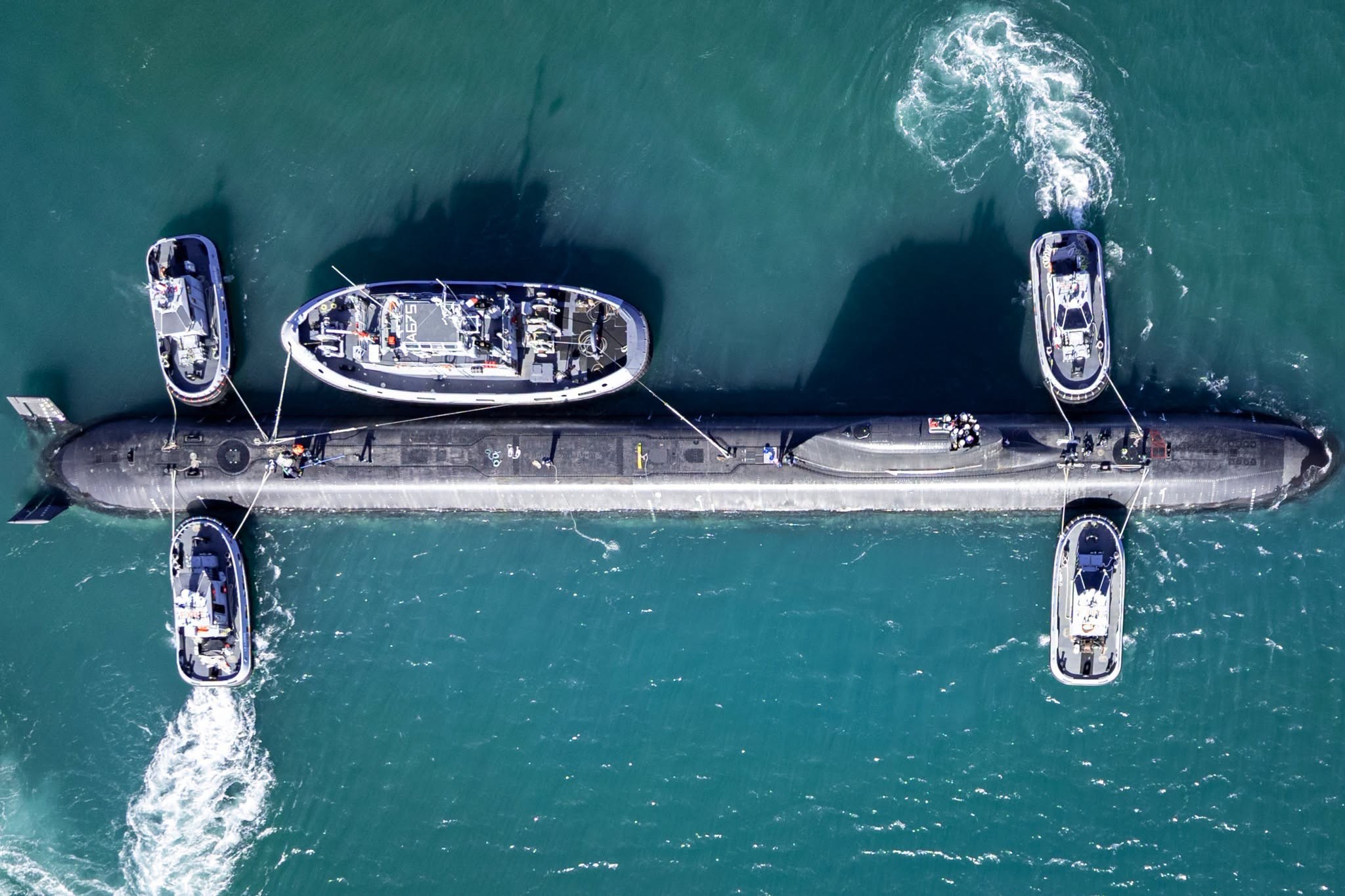
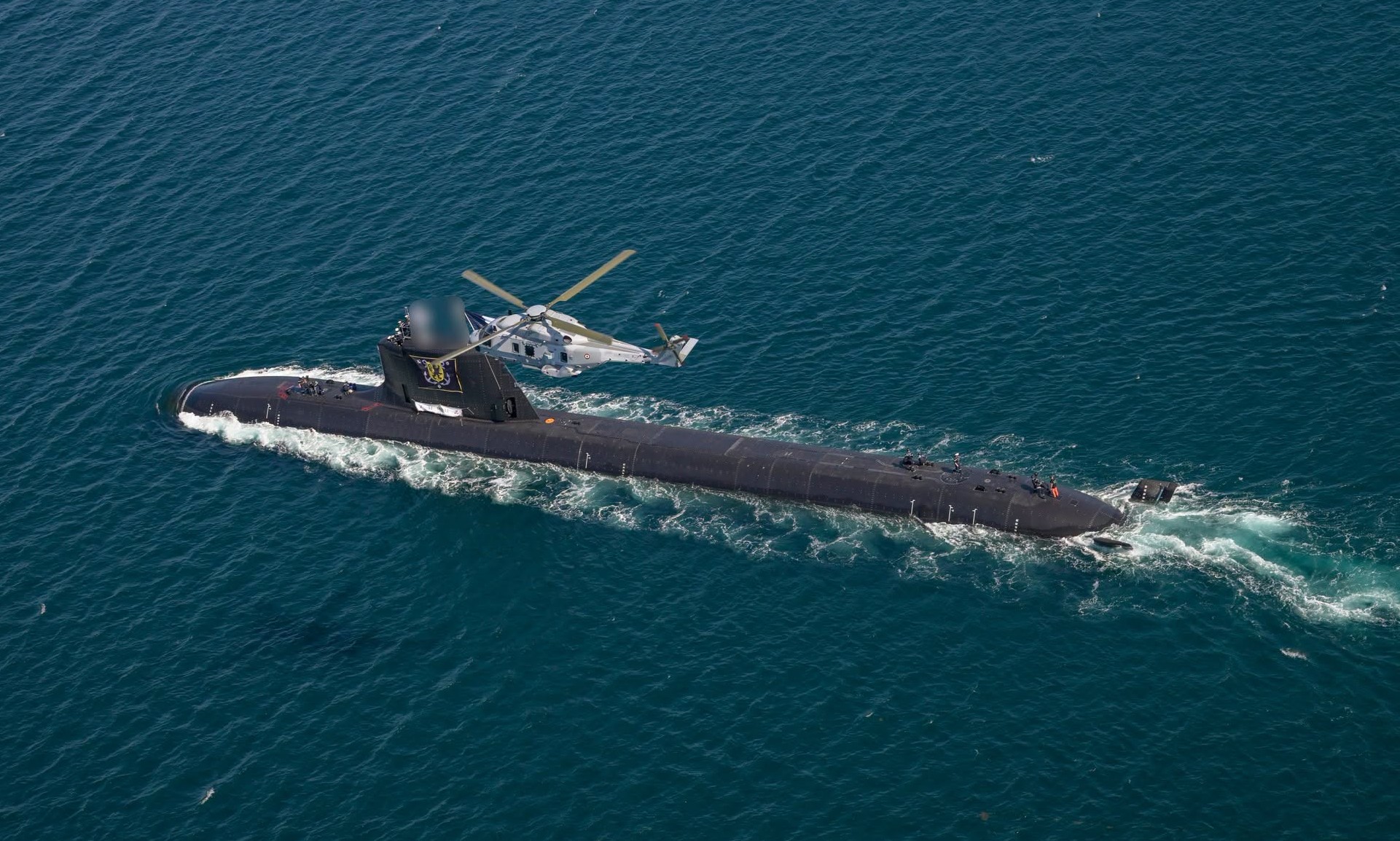
The Suffren-class submarines are 99 metres long, with a hull diameter of 8.8 metres. They displace 4,700 tonnes surfaced and 5,200 tonnes submerged. The crew numbers more than 60, with additional space for embarked special forces. Naval Group says the boats are designed to be available to the French Navy for more than 270 days a year.
Nuclear propulsion gives the boats what the French ministry describes as remarkable endurance and discretion. Freed from the need to surface or snorkel to recharge batteries, they can stay submerged for weeks and transit at high speed between theatres. The ministry also stresses that the new boats are faster, more enduring and more versatile than their predecessors.
Compared with the Rubis class, the Suffren design is considerably larger, which translates into better living conditions for the crew, greater weapons capacity and room for growth in sensors and systems. That margin matters for submarines that are expected to remain in service for several decades.
Torpedoes, Exocets and naval cruise missiles
The armament of the Suffren class comprises F21 heavyweight torpedoes, SM39 Exocet anti-ship missiles launched from underwater, and MdCN naval cruise missiles. The MdCN allows the boats to strike land targets several hundred kilometres inland. It is a capability the Rubis class never had, and it gives France a discreet long-range strike option from under the sea.
The boats are also designed to support special forces operations. They can carry commandos and their equipment, including underwater delivery vehicles, extending the French Navy's ability to insert teams covertly along hostile coastlines. De Grasse has additionally been fitted with an upgraded SYCOBS combat system and a new-generation electronic warfare suite.
According to the French ministry, the new class keeps France within the small circle of nations that operate modern nuclear attack submarines.
The roles of a French attack submarine
The Suffren-class boats are general-purpose nuclear attack submarines. Their tasks include anti-surface and anti-submarine warfare, protection of the French carrier strike group, and securing the patrol areas of the ballistic missile submarines that carry France's nuclear deterrent. They are also used for intelligence gathering, land strikes and special operations.
This wide range of missions reflects France's global interests. The French Navy operates in the Atlantic, the Mediterranean, the Indian Ocean and the Pacific, and it maintains a permanent presence in overseas territories. A submarine that can cross oceans at speed and remain on station for long periods is central to that posture.
The industry behind the Barracuda programme
Around 2,500 people work on the Suffren-class series, including some 800 employed by subcontractors. The boats are built in Cherbourg, while Naval Group provides in-service support at the Toulon naval base on the Mediterranean, the home port of France's attack submarine force. The Barracuda programme is expected to shape French submarine forces until at least 2060.
For Naval Group, the programme is also a showcase. The company has drawn on its experience with nuclear boats in marketing its conventional designs abroad, and its Scorpène submarine has been sold to navies in South America and Asia. In Europe, however, the company recently lost one of the most closely watched submarine competitions of the decade, Poland's Orka programme.
Poland opts for conventional boats under Orka
The Polish Navy is rebuilding its submarine force on a different model, tailored to the Baltic Sea. On 29 June 2026 in Gdynia, Poland's Armament Agency signed a contract with Saab for three A26 submarines, known in Sweden as the Blekinge class. The deal, worth around SEK 47 billion (about $4.8 billion), also includes weapons, logistics and training packages. It was signed in the presence of Polish Prime Minister Donald Tusk, Swedish Prime Minister Ulf Kristersson and the two countries' defence ministers, Władysław Kosiniak-Kamysz and Pål Jonson.
Warsaw announced Sweden as its partner in November 2025, ending years of uncertainty over one of the Polish Navy's most delayed modernisation programmes. Saab's A26 beat offers from France's Naval Group, which proposed Scorpène-class submarines armed with NCM cruise missiles, as well as Germany's TKMS, Italy's Fincantieri and South Korea's Hanwha. The first Polish A26 is expected around 2030-2031, with deliveries of all three boats running until 2038.
The submarine contract sits at the heart of a broader security partnership between Poland and Sweden, the Baltic Sea Pact, launched alongside the signing. For both countries, which now face Russia's Baltic Fleet together as NATO allies, closer naval cooperation has become a shared strategic priority.
A bridge to the A26 and a Polish industrial role
Until the new boats arrive, Poland will receive an interim solution. From next year, the Polish Navy is due to operate a Swedish A19 Södermanland-class submarine, which will replace ORP Orzeł, the Kilo-class boat that has served Poland since the 1980s. The former Norwegian Kobben-class submarines that once made up most of the Polish fleet have already been retired, leaving the gap-filler as the bridge to a new generation.
The contract also provides for the transfer of technology and know-how to Polish industry in maintenance, repair and overhaul. Polish Armaments Group (PGZ) and Saab have agreed to establish a service centre for the A26 boats in Poland, ensuring that the submarines can be supported domestically throughout their service life. The contract is financed from a mix of the state budget and the Armed Forces Support Fund.
French propulsion for Polish submarines
Although Naval Group did not win in Poland, French industry still has a share in the Orka programme. On 16 October 2026, Jeumont Electric announced a contract to supply Saab with three complete electric propulsion systems for the A26 PL submarines. The Polish boats will receive equipment from the same company that supplies Sweden's Blekinge class, and whose motors have been working in Swedish-designed submarines for 30 years.
It was the first publicly known equipment contract for the Polish boats since the main contract was signed in June. It also illustrates how European submarine programmes increasingly rely on cross-border supply chains, even when the main contractor comes from another country.
Two navies, two different answers to the same question
Set side by side, the French and Polish programmes illustrate how geography shapes naval requirements. France, a nuclear power with interests on every ocean, needs large submarines capable of months-long missions far from home, escorting a carrier group and striking targets ashore. Its nuclear attack submarines are built for distance, speed and endurance.
Poland operates in the shallow, crowded and confined waters of the Baltic, where silence, a small signature and the ability to stay submerged for long periods without snorkelling matter most. The A26 was designed for exactly those conditions and is equipped with air-independent propulsion, allowing it to remain underwater far longer than a traditional diesel-electric boat. Saab describes the design as engineered specifically for the demanding operating conditions of the Baltic Sea.
For the Polish Navy, Orka means its first newly built submarines in decades and a significant boost to NATO's undersea capability in the Baltic. For France, De Grasse brings the Barracuda programme two-thirds of the way to completion. Together, the two programmes show European navies investing in submarine forces on a scale not seen since the end of the Cold War.
Source: Gazeta Morska
Comments (0)
The discussion is moderated by the editors: a comment appears after review. Your e-mail address is not published.
Nobody has commented on this article yet.