







Explosions reported in Baltiysk as drones allegedly target Russia's main Baltic Fleet base
Air raid sirens across Russia's Kaliningrad exclave, reports of blasts and air defence fire around Baltiysk, restrictions at Khrabrovo airport. On the evening of Saturday 21 November, Ukrainian media reported a possible drone attack on the main base of Russia's Baltic Fleet, a few dozen kilometres from the Polish border. Neither side has confirmed a strike, and Russian officials speak only of a false alarm.


In brief
Sirens across Kaliningrad and reports of blasts near Russia's Baltic Fleet base in Baltiysk. What is confirmed and what remains unverified.
If confirmed, it would be the first attack on the Russian exclave bordering Poland and Lithuania since Moscow launched its full-scale war against Ukraine. For now, the picture rests on residents' accounts, footage shared by monitoring channels and a brief statement from the regional governor.
What is established
An air raid alert was declared in the region at around 19:00 local time (18:00 CET). According to the Ukrainian news agency UNN, citing the BBC, sirens sounded in Kaliningrad, Svetlogorsk, Zelenogradsk, Pionersky and Svetly.
Regional governor Alexei Besprozvannykh confirmed that the warning system had been activated. According to his statement, the alert was triggered in the Neman district, on the border with Lithuania, after a suspicious aerial object was detected approaching from that country. Specialists checked the report and concluded there was no threat.
The governor published the statement at around 21:30 local time. It made no mention of Baltiysk.
The alert affected air traffic and communications. At Khrabrovo airport near Kaliningrad every take-off and landing required separate clearance, and the restrictions were lifted at 18:43 CET. Mobile operators warned subscribers of possible interruptions to mobile internet. Ukrainian and Russian media say the sirens sounded more than once that evening.
What remains unverified
The first reports of explosions around Baltiysk came from Ukrainian monitoring channels on Telegram, including Exilenova+ and Dnipro Osint. They described multiple blasts, the sound of drones and Russian air defences in action. The Kyiv Independent, which reported these claims, said it could not verify them.
Preliminary reports suggest the target may have been port infrastructure at the Baltic Fleet base. RBC-Ukraine went as far as publishing coordinates of an alleged explosion site near the port. Ukrainian blogger Andrii Smolii wrote of a red glow and thick smoke over the region, but neither the location nor the cause of the fire has been established.
The Unian news agency went furthest, stating that "Ukrainian drones attacked military targets in Kaliningrad Oblast for the first time". For now this is the agency's own claim, not the position of the Ukrainian authorities. Kyiv has made no official comment.
The explosion photo said to come from Iran
The greatest doubts surround the material presented as proof of a strike. According to the Russian news agency EADaily, the press service of the regional government declared a widely shared photo of an alleged explosion in Baltiysk to be fake. Mariam Bashkirova, the governor's press secretary, reposted a message saying the image shows a fire on Iran's Qeshm island on 9 November. The same agency claims that a Ukrainian outlet also acknowledged the first photo was not genuine.
That account cannot be independently verified at this stage, and neither can the authenticity of the other footage from Baltiysk. Moscow has confirmed neither a strike on the base, nor damage, nor casualties. A Ukrainian drone attack therefore remains one of the hypotheses.
Two accounts that do not match
The official Russian statement and the reports from Baltiysk describe two different places. The governor refers to a single object over the Neman district, at the eastern edge of the exclave. The accounts of explosions concern Baltiysk, on its western tip, more than a hundred kilometres away. The governor's statement therefore neither confirms nor denies what is said to have happened at the base.
It is also unclear where the drones would have come from. Monitoring channels, citing Russian accounts, suggested a launch from a vessel. RBC-Ukraine reported that unidentified drones had earlier been observed over the Gulf of Finland. None of these versions has been confirmed.
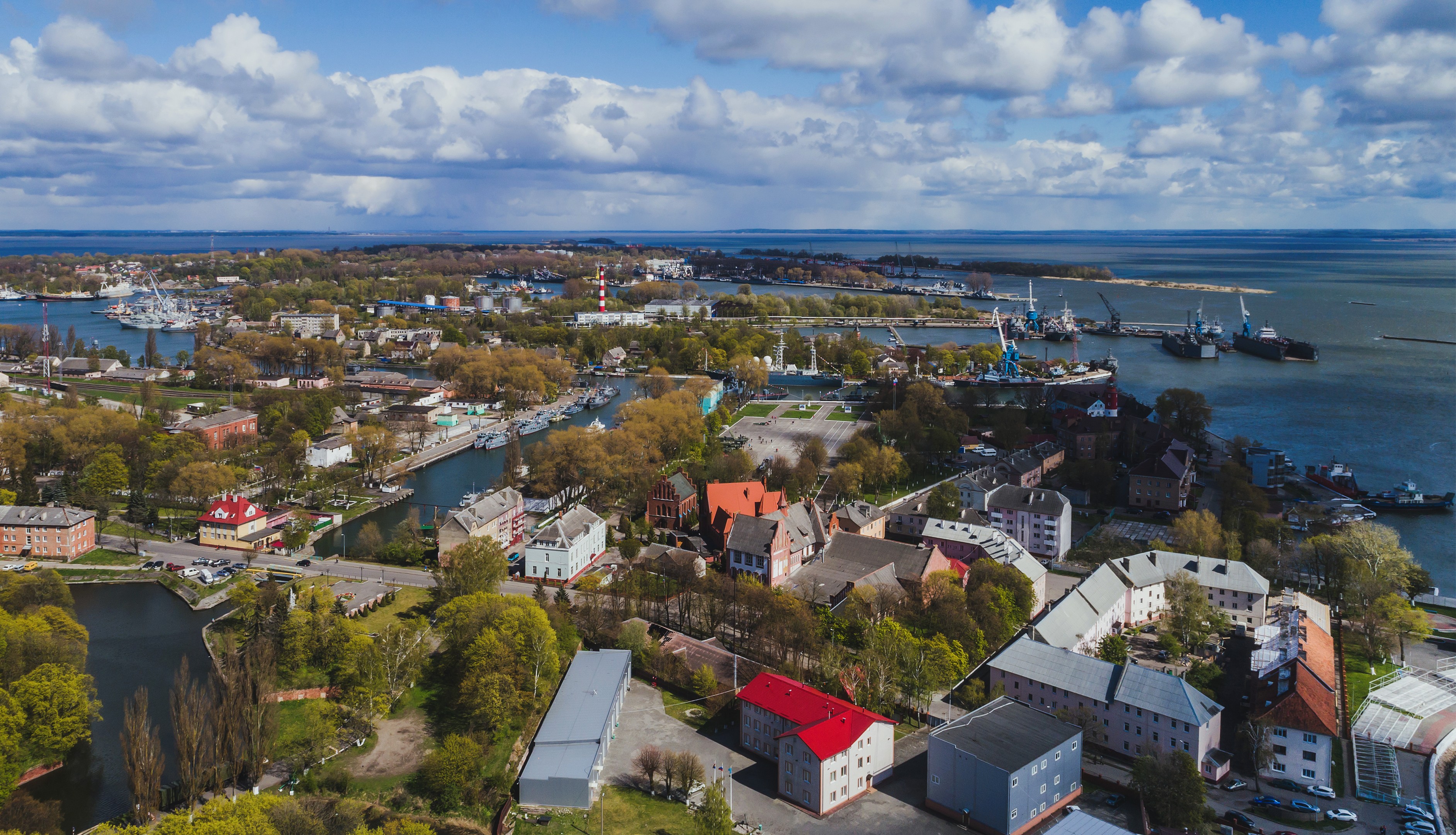
Why Baltiysk matters
Baltiysk, historically known as Pillau, is the main naval base of the Baltic Fleet and Russia's westernmost naval port. It sits on the Strait of Baltiysk, the only natural link between the Vistula Lagoon and the open sea, a few dozen kilometres from the Polish border on the Vistula Spit. Dependence on that strait was one of the reasons Poland built its own shipping canal across the spit.
For Moscow the base is of strategic importance: since Finland and Sweden joined NATO, the Kaliningrad exclave has been Russia's only foothold in the central Baltic. Several hundred kilometres and the territory of NATO states or Belarus separate it from Ukraine, which helps explain why it has not previously been the target of any confirmed strike. In May 2026 a drone threat was declared there, but no attack followed.
Another tense week in the Baltic
Saturday's reports follow a series of incidents in recent days. On 11 November an explosion occurred on board the Baltic Fleet missile corvette Naro-Fominsk near the island of Gogland in the eastern Gulf of Finland. The Security Service of Ukraine claimed a drone strike. Later the Finnish Border Guard reported a fire on the Russian cargo ship Sparta II, which according to media reports was sailing through the Gulf of Finland to the Kaliningrad exclave. Daily Mare has covered both.
Source: Gazeta Morska
Comments (0)
The discussion is moderated by the editors: a comment appears after review. Your e-mail address is not published.
Nobody has commented on this article yet.