







Econowind turns ten with more than 170 VentoFoils sold as wind propulsion goes mainstream
Dutch wind-assisted ship propulsion specialist Econowind is celebrating its tenth anniversary, having sold more than 170 VentoFoil units to shipping companies worldwide. The milestone reflects a broader shift in how commercial shipping sees wind, from a niche experiment to a commercial tool for cutting fuel costs and emissions.

In brief
Dutch WASP specialist Econowind marks its tenth anniversary with more than 170 VentoFoil units sold. From early prototypes on a car roof to the 30-metre 5-series for deepsea ships, the company has grown with a wind propulsion market that now counts over 100 large vessels and doubles every year.
Founder Frank Nieuwenhuis launched Econowind in 2016 in collaboration with ship design firm Conoship International. At the time, much of the maritime sector was sceptical about wind-assisted propulsion. Nieuwenhuis set out to show that compact, vertical wings could cut a cargo ship's fuel use. His first tests were hands-on: he bolted wooden prototypes to the roof of his car and used a vacuum cleaner to mimic the suction that keeps air flowing smoothly over the wing.
Taking the concept to sea was not smooth. Early trials required manual operation by an onboard technician and showed that smaller wings delivered limited savings on larger ships. Econowind responded with automated bridge controls that react to changing winds and tilting designs that let crews lower the wings during cargo handling or heavy weather. That work became the basis for the 3-series VentoFoil, the company's best-selling unit.
From Gdynia to deepsea fleets
VentoFoils have also been fitted in Poland. In May 2023, the units were installed at PGZ Naval Shipyard in Gdynia on the 45-year-old cement carrier Sunnanvik, owned by Eureka Shipping, part of SMT Shipping, which expected fuel savings of around 10%.
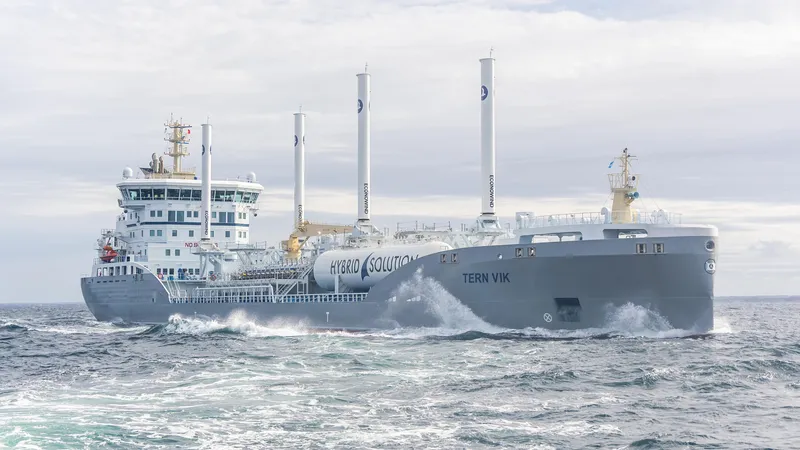
Other recent projects include five methanol-ready hybrid tankers for Swedish owner Terntank, each fitted with four 16-metre wings, and the GROOT XL general cargo newbuild series for Leonhardt & Blumberg, with the first vessel, HANSA DREJOE, fitted at Royal Niestern Sander in August 2026. In April 2026 Econowind unveiled the 30-metre steel 5-series VentoFoil for oceangoing vessels, with Boomsma Shipping as the launch customer.
A market doubling every year
Econowind has grown alongside the wider WASP market, where installations are roughly doubling every twelve months. According to the International Windship Association (IWSA), more than 100 large commercial cargo ships were using wind propulsion by June 2026, with over 230 systems installed and more than 5 million tonnes deadweight, up from 21 vessels in May 2022.
– In terms of the number of vessels installed, Econowind is right in the front line, definitely one of the frontrunners. What has changed most over the past decade is perception: shipping now sees wind not as a romantic throwback, but as a 21st-century toolbox of commercial solutions – said Gavin Allwright, Secretary General of the IWSA.
Cost is the main driver. Fuel accounts for around half of a ship's operating expenses, while alternative fuels such as green methanol and ammonia remain expensive and their supply networks are still being built. At the same time, the EU Emissions Trading System and FuelEU Maritime, which grants a reward factor for wind propulsion and allows compliance pooling, are turning emissions cuts into a direct financial case. VentoFoils ease the load on the main engine and work alongside hull and voyage optimisation as well as future low-carbon fuels.
– This journey has been full of trials and learning by doing. It would not have been possible without the people behind Econowind and everyone who supported us along the way – said Frank Nieuwenhuis, founder of Econowind.
To mark the anniversary, Econowind is publishing a series of ten stories told by clients, shipyards and other maritime stakeholders. In its second decade, the company plans to expand manufacturing capacity and roll out the 5-series for deepsea fleets.
– Wind propulsion is approaching an inflection point. The groundwork has been laid by technology providers such as Econowind, and the sector is now absolutely ready to ride the wave – Gavin Allwright added.
Source: Gazeta Morska
Comments (0)
The discussion is moderated by the editors: a comment appears after review. Your e-mail address is not published.
Nobody has commented on this article yet.