







Bat rays settle in Aquapark Reda, the only place in Poland to see them
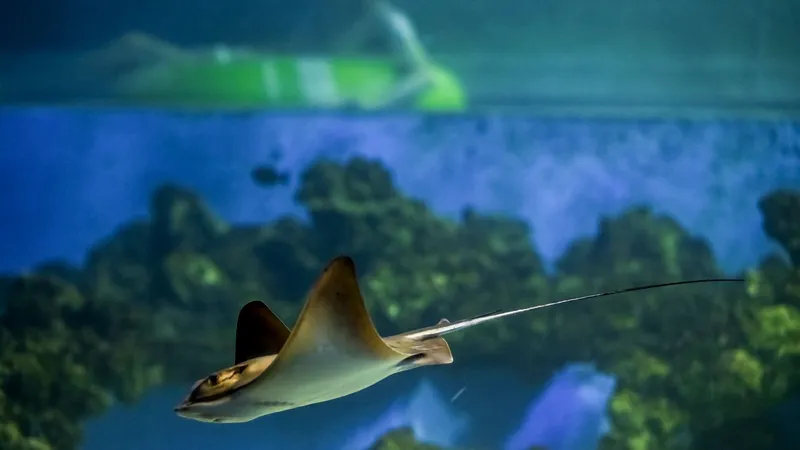
Three bat rays (Myliobatis californica) now share the refurbished aquarium at Aquapark Reda with four sharks. No other Polish aquarium displays this species. Adults can reach almost two metres across, fly through the water like birds and find prey hidden in the sand.

In brief
Three bat rays now live at Aquapark Reda. Learn how they find hidden prey, what their venomous spine is for and why Reda is the only place in Poland to see them.
The rays arrived in Reda together with a whitetip reef shark, a blacktip reef shark and two leopard sharks. All of the animals came from the United Arab Emirates and are on loan, so the aquapark acts as their caretaker rather than their owner. Loans and exchanges between institutions are standard practice among zoos and public aquariums, as they help build collections while reducing the need to take new animals from the wild.
Only in Reda
We checked which rays Poland's largest aquariums display. The Africarium at Wrocław Zoo keeps several species of eagle rays and stingrays, and eagle rays glide over visitors in the Orientarium at Łódź Zoo. Both show relatives of the Reda rays, but not this species. Anyone who wants to see a bat ray in Poland has to go to Reda.
Other rays in Gdynia
To be fair, rays can also be seen elsewhere in the Tricity. According to its 2026 exhibition catalogue, Gdynia Aquarium displays four other species: the bluespotted ribbontail ray (Taeniura lymma) from coral reefs, the freshwater ocellate river stingray (Potamotrygon motoro) from South America, the common eagle ray (Myliobatis aquila), a close relative of the bat ray from the same genus, and the thornback ray (Raja clavata), which, unlike stingrays, lays eggs in horny capsules. None of them is a bat ray, which in Poland can only be seen in Reda.
Gdynia and Reda in one day
That makes for a good day out. Start with a walk around Gdynia's seafront, along Kościuszko Square and the Seaside Boulevard, and a visit to the aquarium. Then take the SKM commuter train to Reda for a few hours at the aquapark: swimming, relaxing and watching the bat rays and sharks in the aquarium. To finish, step into the immersive show about Fryderyk Chopin at the Art Box gallery.
Wings like a bat
The bat ray is an eagle ray, a family that swims by flapping its pectoral fins like wings. It is named after those broad, angular fins with pointed tips, which resemble the wings of a bat. Its head sits clearly raised above the disc, with a rounded, lobe-like snout. The upper side is dark brown, olive or almost black, and the underside is white.
The largest bat rays reach about 1.8 metres across and weigh up to 91 kilograms, with females much larger than males [TO BE CONFIRMED: size of the Reda rays].
Built for the seabed
Like all rays, bat rays are cartilaginous fish and close relatives of sharks. Their eyes sit on top of the body, while the mouth, nostrils and gill slits are on the underside, which often looks like a smiling face when a ray glides past the glass. When resting on the bottom, they draw water in through spiracles behind the eyes to keep sand out of their gills. Like sharks, they sense the faint electric fields of hidden prey with the ampullae of Lorenzini, named after the Italian physician Stefano Lorenzini, who described them in the 17th century.
From the coast of California
Bat rays live in the eastern Pacific, from Oregon to the Gulf of California and around the Galápagos Islands, usually in water shallower than about 46 metres. They favour muddy and sandy bays, rocky bottoms and kelp forests. They often swim alone but can gather in schools of thousands, and they sometimes leap out of the water and skim along the surface.
Clams are their main food, along with worms, shrimp, crabs and small fish. A bat ray flaps its fins to clear away sand and digs with its snout, then crushes shells with plate-like teeth, spits them out and eats only the soft parts. Oyster farmers once treated them as pests, but bat rays rarely eat oysters and help growers by eating the crabs that do.
A venomous spine
At the base of its long, whip-like tail, the bat ray carries a barbed venomous spine, sometimes two or three. It is used only in self-defence, so the species poses little threat to people.
Bat rays give birth to live young. After a pregnancy of 8 to 12 months, a female delivers 2 to 12 pups in shallow water, tail first, with their fins rolled over their backs. The species is listed as Least Concern by the IUCN, although more than a third of all shark, ray and chimaera species are threatened, according to a 2021 analysis in Current Biology.
How to see them in Reda
The three bat rays share the refurbished and secured aquarium with the sharks and can be seen during the aquapark's opening hours, daily from 9 am to 10 pm and from 8 am during the summer holidays. There are three ways to watch them. The calmest is the rest area by the aquarium, where visitors can sit by the glass and wait for a ray to glide past, showing its "smiling face", raised head and wing-like fins. For more thrills, the 60-metre Shark Slide runs through a glass tunnel across the bottom of the aquarium, with rays and sharks swimming overhead. The third option is Deep Blue, a pool more than two metres deep separated from the aquarium by a transparent wall, where swimmers can come almost face to face with the rays.
Source: Gazeta Morska
Comments (0)
The discussion is moderated by the editors: a comment appears after review. Your e-mail address is not published.
Nobody has commented on this article yet.