







Baltica 2 completes all 111 foundations as PGE and Ørsted target first power in Q2 2027
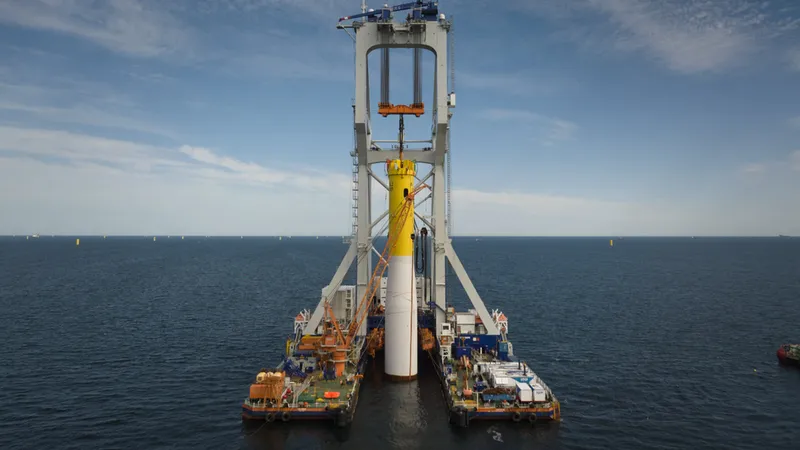
All 111 foundations for the turbines and offshore substations of the Baltica 2 offshore wind farm are now in place on the Baltic seabed. PGE and Ørsted are moving on to the next stages of offshore work, including secondary steel, offshore substations and export cables, with turbine installation due to begin in the first quarter of 2027. First power from the largest wind farm under construction in the Polish Baltic is expected in the second quarter of 2027, with full commercial operation planned for the end of that year.

In brief
All 111 foundations for the 1.5 GW Baltica 2 offshore wind farm are in place. PGE and Ørsted will begin turbine installation in Q1 2027, with first power expected in Q2 and full commercial operation by the end of 2027. PGE Baltica's Bartosz Fedurek says the project could save Poland around one billion cubic metres of gas a year.
Baltica 2 is being built around 40 kilometres off the Polish coast near Ustka, within Poland's exclusive economic zone. The 1.5 GW wind farm will cover an area of around 190 square kilometres and consist of 107 wind turbines and four offshore substations. Annual output is expected to reach 5–6 TWh, equivalent to the electricity demand of around 2.5 million households. PGE and Ørsted each hold a 50 per cent stake in the project, which is worth around PLN 30 billion and is the largest investment in the history of Poland's power sector.
Foundations installed in just over three months
The installation campaign began in May 2026, with the ceremonial launch of offshore works held in Gdańsk on 11 May. Van Oord, the main contractor for the transport and installation of the foundations and scour protection, deployed two specialist vessels, Svanen and Aeolus. The final monopile was installed in August, ahead of the original schedule, which had foreseen this stage running into the fourth quarter of 2026.
The steel monopiles are up to 100 metres long, between 7.5 and 10.5 metres in diameter and weigh around 1,900 tonnes each. Of the 111 structures, 107 will support wind turbines and four will carry offshore substations. The monopiles were supplied by EEW and Steelwind.
Work is now under way on more than 400 secondary steel structures on the completed foundations, including anode cages, boat landings and platforms. By the end of the year, work is also due to continue on the offshore substations and the export cables that will carry electricity ashore. Installation of the turbines and the inter-array cables connecting them to the substations is scheduled for 2027.
Bartosz Fedurek: Baltica 2 could cut gas consumption by around one billion cubic metres a year
The significance of the project was highlighted by Bartosz Fedurek, President of the Management Board of PGE Baltica, at the Offshore Wind Poland 2026 conference held in Warsaw on 17–18 November. He said that once Baltica 2 is operational, Poland will be able to save around one billion cubic metres of natural gas a year. Electricity generated by wind on the Baltic will therefore reduce not only emissions but also demand for fuel currently burned in gas-fired power plants.
The wind farm will use Siemens Gamesa turbines with a rated capacity of 14 MW, which can be increased to 15 MW thanks to the Power Boost function. Measured to the blade tip at its highest point, each turbine will stand more than 250 metres tall. Turbine installation will start in the first quarter of 2027 and will be carried out by Fred. Olsen Windcarrier and Cadeler. According to PGE Vice-President Piotr Dziubałtowski, the infrastructure being installed at sea this year will allow first commissioning power from the turbines to reach the grid at the start of the second quarter.
Baltica 2 is the first step in PGE's wider offshore programme. The company is also developing Baltica 3, with a capacity of around 1 GW, and Baltica 9+, with a capacity of around 1.3 GW. Together, the three projects, all of which have secured contracts for difference, will total around 3.8 GW. This will allow the group to meet its strategic target of 4 GW of offshore wind capacity by 2035.
Urszula Zielińska: the Polish Baltic deserves at least 18 GW
The importance of Baltica 2 for the entire sector was underlined at the launch of offshore works by Poland's Ministry of Climate and Environment, represented by Minister Paulina Hennig-Kloska and Deputy Minister Urszula Zielińska. The deputy minister said that work was being finalised on Poland's National Energy and Climate Plan to 2040, which sets significantly higher ambitions for offshore wind.
– The Polish Baltic Sea deserves at least 18 GW of new, clean offshore capacity by 2040 – said Urszula Zielińska, Deputy Minister of Climate and Environment.
In her view, the Polish offshore market will become one of the most attractive investment destinations in Europe. Urszula Zielińska has also announced plans to shorten administrative procedures to a maximum of two years for offshore wind farms and one year for onshore projects. Renewable energy acceleration areas, introduced under the EU's RED III directive, are among the tools intended to achieve this. As offshore wind farms take many years to prepare and require environmental, geological and technical surveys, faster procedures are expected to speed up the next wave of projects and attract more investors to the Polish Baltic.
Ustka, Choczewo and Gdańsk at the heart of the project
Baltica 2 is also providing a boost to the economy of Pomerania. PGE Baltica's operations and maintenance base is being built in the port of Ustka, from where the wind farm will be serviced for at least 30 years. The base will be used to transfer technicians offshore, store spare parts and coordinate maintenance work.
The onshore grid connection infrastructure for the wind farm is being built in the municipality of Choczewo. Since July 2026, Choczewo has been feeding electricity into the national grid from Poland's first offshore wind farm, Baltic Power, and Baltica 2 will be the next wind farm connected there.
The T5 terminal in the Port of Gdańsk serves as the installation port for the entire project. The facility, covering more than 21 hectares and developed by Istrana, part of the Baltic Hub group, will handle the storage, pre-assembly and load-out of components for all 107 turbines. The development of infrastructure in Ustka, Choczewo and Gdańsk is creating new jobs and orders for regional transport, engineering, construction and logistics companies.
Energy security and protecting the Baltic
Domestic sources of energy in the Baltic will reduce Poland's dependence on imported fuels and the share of fossil fuels in its energy mix. Once completed, Baltica 2 will be the largest offshore wind farm in the Baltic Sea, and the experience gained during its construction will benefit PGE's subsequent projects on the Słupsk Bank.
Offshore works are being carried out with a focus on limiting the impact on the marine ecosystem. Bubble curtains were used during foundation installation to reduce the spread of underwater noise, and the presence of marine mammals around the construction site was continuously monitored.
Source: Gazeta Morska
Comments (0)
The discussion is moderated by the editors: a comment appears after review. Your e-mail address is not published.
Nobody has commented on this article yet.