







A vanished 19th-century cash register and a latrine under the lift as Gdańsk's Madison gallery turns 23
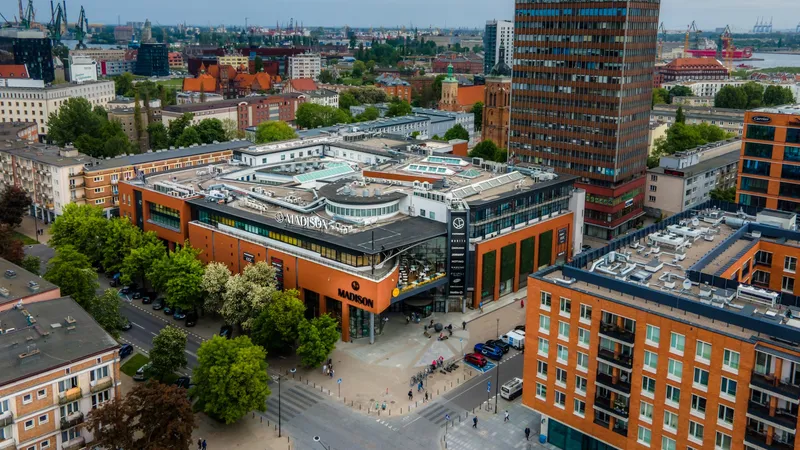
Madison shopping gallery in Gdańsk celebrates its 23rd birthday today. On 28 November 2003, the building on Rajska Street was inaugurated with a baroque-themed gala featuring singers Justyna Steczkowska and Stanisław Soyka and rally driver Krzysztof Hołowczyc. Yet the site's history goes back centuries. During construction on the former Paradiesgasse, builders uncovered traces of medieval trade, the remains of old townhouses and a heavy 19th-century cash register that disappeared in unexplained circumstances.

In brief
Madison shopping gallery in Gdańsk celebrates its 23rd birthday. During construction on the former Paradiesgasse, builders found traces of medieval trade, a latrine where the panoramic lift now stands and a 19th-century cash register that mysteriously disappeared. The ceiling above the car park was designed as a civilian shelter.
For centuries, the area around today's Rajska Street was at the heart of Gdańsk's commercial life. Instead of shop windows, cafés and escalators, it was home to craftsmen's workshops, merchants and carts. Today, thousands of people pass through the gallery every day and millions visit each year, yet few are aware of the remarkable stories hidden in its past.
The old Paradiesgasse beneath the gallery
Preparing the site for Madison was no ordinary development. Because of the area's historical value, construction was preceded by archaeological research, and the project had to follow heritage conservation guidelines. The first earthworks and surveys began in 1995, and construction of the gallery started in 1999.
Despite the earlier surveys, further traces of the past continued to emerge during construction. Finds included beer and water bottles and everyday objects that shed light on the lives of the people who once lived in this part of the city. Beneath the future gallery lay the remains of townhouses destroyed during the war.
– The whole site was burnt-out townhouses down to the foundations, and all sorts of things were dug out of them – recalls Grzegorz Szydełko, who was involved in the project and now manages the building.
The site was part of Gdańsk's historic trading district, and the former Paradiesgasse ran across the area now occupied by the building. Its route was incorporated into Madison's architecture: an internal passage follows the line of the old street, and its name is commemorated inside the gallery.
The cash register that vanished overnight
Some of the discoveries read like the plot of a historical film. Where the panoramic lift now stands, the remains of an old latrine were found. But it is the story of an old shop cash register that most captures the imagination.
During earthworks, workers came across a heavy, locked cash register with two drawers. According to accounts, it dated from the 19th century and weighed around 50 kilograms. No one knew what was inside, and speculation ranged from old coins, perhaps denarii, perhaps guilders. Additional security staff were called in to guard the find. By the next morning, the cash register was gone.
– No one knows how it disappeared. A cash register that weighed a good 50 kilograms – says Grzegorz Szydełko.
To this day, no one knows what was inside or what became of the find. The missing cash register remains one of the most intriguing stories linked to the construction of the gallery.
A car park ceiling designed as a shelter
Madison also features a design detail that few shoppers know about: the ceiling above its underground car park. According to Grzegorz Szydełko, it was designed to serve a protective function as a shelter for the civilian population.
– According to the design, Madison has a ceiling above the car park built as a civilian shelter. That is how it is described in the design, and that is how it was built – stresses Grzegorz Szydełko.
At a time when civil protection and shelters are back on the public agenda, this structural detail of the Gdańsk gallery takes on new significance.
A baroque gala and Krzysztof Hołowczyc
On 28 November 2003, Madison officially opened with a gala for invited guests. The organisers opted for a baroque theme, with staff greeting guests in crinolines, colourful tailcoats and powdered wigs, alongside live music, artistic performances and a lavish reception.
The evening featured performances by Justyna Steczkowska and Stanisław Soyka, with Krzysztof Hołowczyc as a special guest. The building was blessed by Archbishop Tadeusz Gocłowski, and the ribbon was cut by the then Mayor of Gdańsk, Paweł Adamowicz. The following day, 29 November, the gallery opened to the public.
Witness to the rise of Polish brands
Madison was built at a time when Polish retail and the domestic fashion industry were gathering momentum. Among its tenants was Gdańsk-based LPP, whose brands Reserved, Cropp and later Mohito were only beginning to build the international recognition they enjoy today.
– LPP wasn't a listed company then, it was a small firm that was just getting started and still building itself up – recalls Grzegorz Szydełko.
The gallery has witnessed profound changes in the Polish economy, retail and fashion. Among the people linked to its history is Olympic champion race walker Robert Korzeniowski, who rented one of its units. Mayor Paweł Adamowicz was a frequent visitor and used to have his Christmas presents wrapped there. Today, shoppers may also spot reality TV personalities buying premium clothing for their pets.
Shopping without the rush
Not only has the retail offer changed, but so has the way people shop. Those who remember Madison's early years recall a very different approach, with customers happy to spend hours in the gallery.
– Back then nobody was in a hurry. People came with specific needs, but they would look at everything from every angle. You would often chat with the shop assistants for a long time – says Grzegorz Szydełko.
Families treated shopping as an occasion to go out together and meet others. In a world of constant hurry, this perspective has become a source of inspiration for the modern gallery.
Madison moves closer to local residents
Over more than two decades, Madison has changed alongside Gdańsk. It continues to develop its retail and service offer while opening up increasingly to local culture, creators and community events. Examples include the "Otwarte 3miasto" fairs, art exhibitions and initiatives that give space to Polish brands and independent businesses, where shoppers can discover genuine handmade gems.
Anna Thomas, Managing Director of Madison, aims to open a new chapter in the gallery's communications, focusing on closer ties with residents and making greater use of the building's history.
– Madison has enormous capital that cannot be built in a few months: 23 years of history, a great location and relationships with people who have been connected with this place for years. I want Madison to be more than a shopping gallery, a place for meetings, local initiatives, culture and interesting experiences. We want to be closer to the residents of Gdańsk, listen to their needs and show that in the city centre you can still find a space with its own character – says Anna Thomas, Managing Director of Madison.
Madison brings together different eras: medieval trade routes, old workshops, the history of Gdańsk commerce, the beginnings of modern Polish brands and the everyday life of today's residents. Twenty-three years after it opened, it is clear that in 2003 Gdańsk gained not only a new shopping gallery but also a place with a history still worth discovering.
Source: Gazeta Morska
Comments (0)
The discussion is moderated by the editors: a comment appears after review. Your e-mail address is not published.
Nobody has commented on this article yet.