







A second lane on the Szczecin fairway as PLN 135 million contract signed for Police Canal passing section
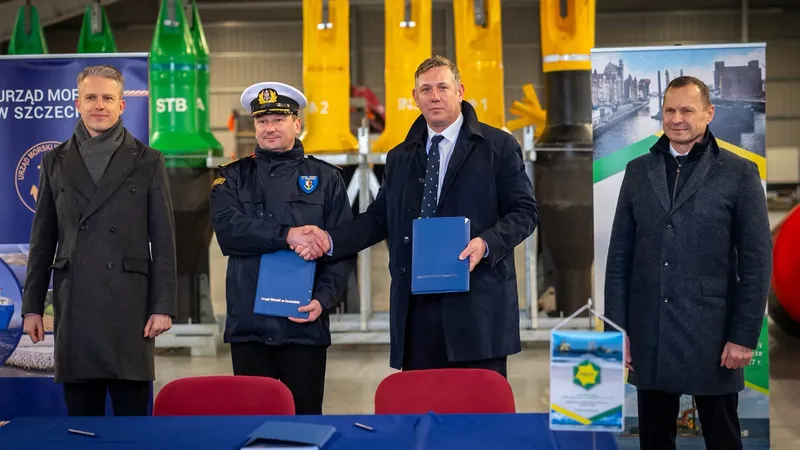
The Maritime Office in Szczecin signed a contract on 27 November to build a passing section for ships on the Świnoujście-Szczecin fairway. For around PLN 135 million, a consortium of Gdańsk-based Przedsiębiorstwo Robót Czerpalnych i Podwodnych (PRCiP) and Romgos Gwiazdowscy of Jarocin will deepen a stretch of the Police Canal (Kanał Policki) of more than five kilometres to 12.5 metres and widen it to 100 metres. The works are scheduled to take 20 months. Once complete, the largest ships calling at Szczecin will no longer have to wait for the narrow stretch of fairway near Police to clear.

In brief
The Maritime Office in Szczecin has signed a PLN 135 million contract with PRCiP and Romgos Gwiazdowscy to build a passing section in the Police Canal. Deepened to 12.5 m and widened to 100 m over 5.32 km, it will allow two-way traffic of large ships on the Świnoujście-Szczecin fairway.
The contract was signed at the Maritime Office's Navigation Marking Base in Szczecin in the presence of Arkadiusz Marchewka, Secretary of State at Poland's Ministry of Infrastructure. The project, officially titled "Improving access to the seaport of Szczecin - construction of a passing section for ships on the Świnoujście-Szczecin fairway", is funded from the state budget. Its total cost is estimated at around PLN 150 million. In addition to the construction works, this covers design documentation, analyses and maps, seabed sampling, the contract engineer and legal services.
Police Canal inbound, West Oder outbound
The works will cover the Police Canal between kilometres 44 and 49.5 of the fairway. Along a 5.32-kilometre section, the canal will be deepened to 12.5 metres and widened at the bottom to 100 metres, and to 130 metres on bends. Including its slopes, it will be around 225 metres wide, and around 250 metres on bends. According to Maritime Office estimates, more than 3.6 million cubic metres of material will be dredged and deposited at the W28 disposal site on the Szczecin Lagoon. The new section will be marked by nine buoys.
At present, the fairway in this area follows the West Oder (Odra Zachodnia), as the parallel Police Canal is too narrow and too shallow for large vessels. Maritime Office data show that for almost four kilometres the canal is currently 70 metres wide and 4.5 metres deep. Only a section of just over a kilometre already has a depth of 12.5 metres.
After the works, traffic will be separated. Ships bound for Szczecin will use the Police Canal, while vessels leaving the port will sail along the parallel stretch of the West Oder. The passing section is designed for ships between 200 and 240 metres long, up to 32.3 metres in beam and with a draught of up to 11 metres.
An end to one-way traffic for the largest ships
The area around Police is the bottleneck of the entire route to Szczecin. Current port regulations allow two-way traffic here only for ships up to 200 metres in length. Larger vessels must transit the stretch alone, while ships heading in the opposite direction wait. Speaking at the signing, Arkadiusz Marchewka said that large ships here "have difficulty passing each other safely", which often forces the introduction of one-way traffic.
– The largest, 200-metre ships will now be able to pass each other safely – Arkadiusz Marchewka said.
The benefits of the passing section are backed by research from the Maritime University of Szczecin. Professor Lucjan Gucma and Rafał Gralak, together with Burak Kundakçi of Iskenderun Technical University, simulated vessel traffic on the Świnoujście-Szczecin fairway under several infrastructure scenarios. Their findings, published in December 2025, indicate that an additional lane in the Police Canal will reduce ship delays and the costs of congestion on the fairway.
From the Kaiserfahrt to 12.5 metres
The waterway to Szczecin has undergone a century and a half of rebuilding. Between 1874 and 1880, Germany dug the Kaiserfahrt, today's Piast Canal (Kanał Piastowski), bypassing the difficult eastern branch of the Świna. Between 1894 and 1900, the route to Szczecin took on its present course and a length of around 68 kilometres, with a depth of 7 to 8 metres at the time.
For decades, ships reached Szczecin along a fairway 10.5 metres deep, which limited their draught to 9.15 metres. The Maritime Office in Szczecin carried out the modernisation to 12.5 metres in three stages from 2001. Between 2001 and 2004, the bank protection of the Piast Canal was rebuilt, and in December 2012 a consortium of Energopol Szczecin and PRCiP signed the contract for the second stage of works on the Piast and Mielin canals.
The final and largest stage was completed between 2018 and 2022 at a cost of around PLN 1.9 billion, co-financed by the EU's Infrastructure and Environment Operational Programme. The fairway was deepened to 12.5 metres over around 62 kilometres and widened to 100 metres, turning basins were rebuilt, and a passing section and two artificial islands, W22 and W28, built from dredged material, were created on the Szczecin Lagoon. The deepened fairway was opened on 9 May 2022, raising the permitted draught for ships bound for Szczecin from 9.15 to around 11 metres.
A Police Canal passing section years in the making
The first step towards the passing section was taken at the port of Police. From the end of 2018, the Maritime Office carried out a project to improve access to the port, which included deepening the approach channel in the Police Canal to 10.5 metres, with the option of a later upgrade to 12.5 metres, and widening it at the bottom to 100 metres. The contractor was the Dutch company Van den Herik Kust, and the project was financed from the West Pomeranian Regional Operational Programme.
Preparations for the full passing section gathered pace in 2025. In January, the Regional Director for Environmental Protection in Szczecin ruled that the project did not require an environmental impact assessment. In March, the Maritime Office estimated its cost at around PLN 200 million and expected funding from the EU's Connecting Europe Facility. In October, the national water authority Wody Polskie issued the water permit, and the project was named among five investments approved by the government as important for strengthening Polish ports.
In autumn 2025, the Maritime Office was already procuring a survey of the Police Canal seabed for hazardous materials across around 81 hectares, and it launched the tender for the construction works on 13 May 2026. In the end, the passing section will be funded from the state budget, and its cost has come in below earlier estimates.
A contractor that knows the Szczecin fairway
The consortium is led by Gdańsk-based PRCiP, which has already worked on the modernisation of the Świnoujście-Szczecin fairway. Its partner is Romgos Gwiazdowscy of Jarocin. With a 20-month delivery period, the works should be completed in the summer of 2028.
The Police Canal passing section is part of a wider programme that Deputy Minister Arkadiusz Marchewka describes as a "maritime motorway" to the ports of Western Pomerania. In parallel, the Maritime Office is preparing to widen the approach channel to Świnoujście from the current 200-220 metres to 500 metres over 23.5 kilometres. Funded by the Connecting Europe Facility, that project is designed to allow safe two-way traffic of large ships, including LNG carriers calling at the Świnoujście terminal, and is due for completion in April 2028. Together, the two investments will increase the capacity of the entire access system to the ports of Świnoujście, Szczecin and Police.
Source: Gazeta Morska
Comments (0)
The discussion is moderated by the editors: a comment appears after review. Your e-mail address is not published.
Nobody has commented on this article yet.